Kitchen Island Costs and Remodel ROI Explained
A kitchen island adds workspace, storage, and seating. It often becomes the hub of the home. The cost depends on size, materials, and features. A well-planned island can return strong resale value when designed to match your layout and local market.
What It Is
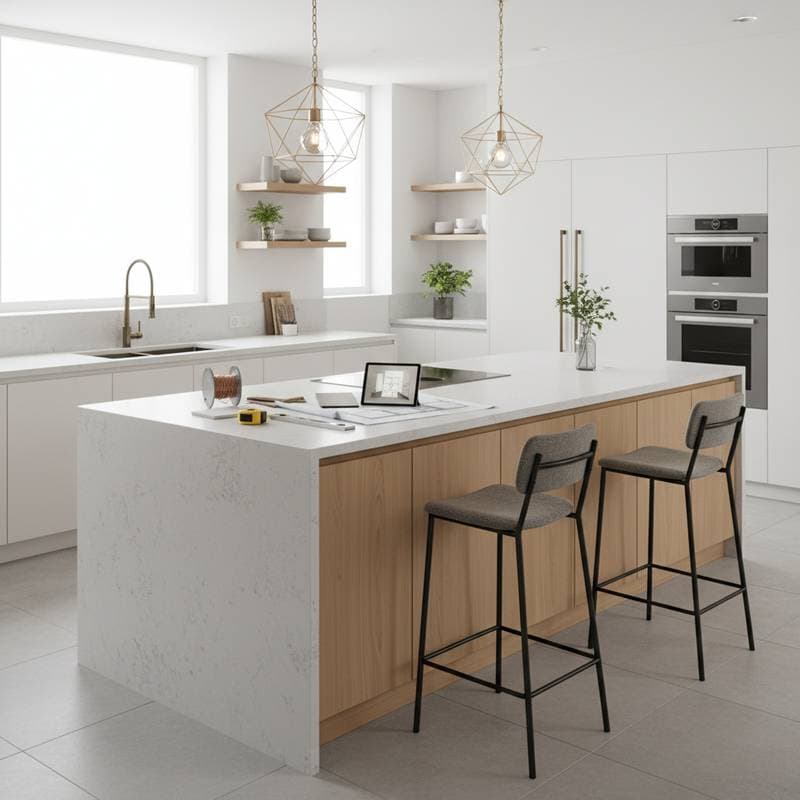
A kitchen island is a centrally located cabinet and countertop unit. It can include drawers, shelves, a sink, cooktop, or seating. Some are stationary and built into the floor. Others are mobile on casters. The main goal is to increase usable workspace and improve traffic flow between cooking, cleaning, and storage zones.
Signs You Need an Island or an Upgrade
- Limited prep space: You struggle to chop, mix, or plate food comfortably.
- Poor workflow: The cooktop, sink, and fridge form a cramped triangle.
- Lack of storage: Pots, pans, or small appliances clutter the counters.
- No seating: Family or guests stand instead of gathering in the kitchen.
- Worn materials: Existing counters or cabinets show moisture or heat damage.
If any of these describe your kitchen, adding or updating an island can improve both function and appearance.
Costs and Cost Factors
Nationally, kitchen island projects range from 3,000 to 12,000 dollars. The median sits near 6,000 dollars. The largest factor is whether the island is purely storage and counter space or includes plumbing and appliances.
| Line Item | Typical Range (USD) | Notes and Variables |
|---|---|---|
| Base cabinets | 1,000 to 3,000 | Stock versus custom sizes |
| Countertop | 800 to 4,000 | Material choice drives cost |
| Electrical outlets | 150 to 500 each | Required by most codes |
| Plumbing (sink or dishwasher) | 500 to 2,000 | Depends on distance to existing lines |
| Flooring patch or reinforcement | 300 to 1,000 | Needed if subfloor is modified |
| Lighting | 200 to 1,200 | Pendant or recessed fixtures |
| Labor and permits | 1,000 to 3,000 | Based on region and complexity |
A low-cost scenario uses stock cabinets with a laminate top and no utilities. This totals about 3,000 dollars. A high-cost scenario features a custom hardwood island with a quartz top, sink, and outlets. This reaches 12,000 dollars or more.
Safety and Code Notes
Electrical rules require at least one outlet on a fixed island in most regions. It must connect to a ground-fault protected circuit. Any sink or dishwasher needs proper venting and trap installation. Heavy islands must be secured to the floor to prevent tipping. Cooking islands often need a ceiling-mounted range hood with ducting. Stone tops can exceed 300 pounds and may need subfloor reinforcement. Always confirm local code requirements before ordering materials.
Regional Factors
In humid or coastal zones, choose sealed hardwoods or composite cabinets that resist warping. In arid regions, wood may shrink, so install with expansion gaps. Cold climates can cause flooring movement, so flexible adhesives help maintain stability. Some cities require electrical outlets on both ends of large islands. Plumbing additions usually need inspection. Always check before cutting into floors or slabs.
Granite or quartz works best in hot-humid and mixed-humid zones. Butcher block suits dry or cold climates if sealed often. Concrete tops work well in arid conditions where humidity is low. In cold regions, schedule construction when heating runs steadily to prevent wood movement. In hot areas, avoid peak humidity to let adhesives cure properly.
FAQs
Does a kitchen island need to be anchored? Yes. Fixed islands must attach to the floor for safety and to meet code. Can you add a sink without redoing the floor? Only if existing plumbing is near the island location. Otherwise, the floor must be cut to run new lines.
Planning Your Installation
Start by measuring your space and sketching traffic patterns. Select materials that suit your climate and maintenance preferences. Obtain permits early and schedule inspections at key stages. This approach ensures the island enhances daily use and supports long-term home value.