Septic System Types and 2025 Replacement Costs
Septic systems manage wastewater for properties without access to public sewers. These underground networks treat household effluent through natural and mechanical processes. When replacement becomes necessary, costs and complexity vary based on system design and site conditions. Homeowners benefit from clear knowledge of options to align choices with budget and environmental needs.
Core Components of a Septic System
Every septic system consists of a tank, distribution network, and drain field. The tank separates solids from liquids, allowing effluent to move to the drain field for soil-based filtration. System selection hinges on factors such as soil percolation rates, lot size, and groundwater depth. Local codes further dictate materials and installation standards, affecting both initial outlay and ongoing upkeep.
Primary Septic System Types
Homeowners encounter several system varieties, each suited to specific site challenges. The choice influences treatment efficiency, space requirements, and financial commitment. Below, key types receive detailed examination for informed selection.
Conventional Gravity System
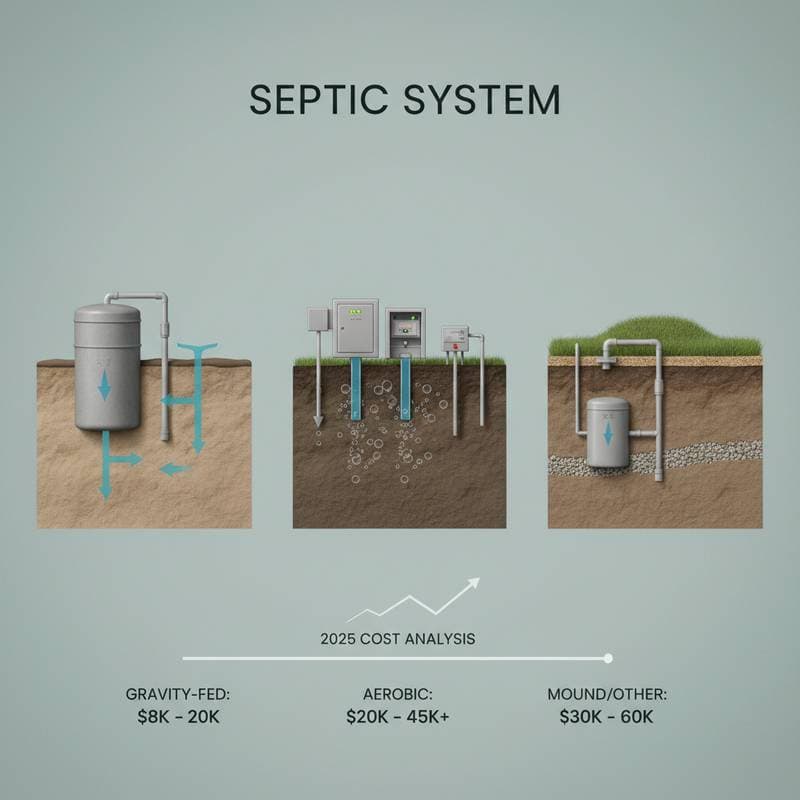
Gravity systems rely on natural downhill flow from the home to the tank and into a gravel drain field. Ideal sites feature permeable soil and sufficient flat area for the field. Installation involves minimal machinery, keeping costs accessible. Replacement typically spans $6,000 to $9,000, covering excavation, concrete or plastic tanks, and basic piping. Homeowners verify soil suitability through percolation tests to avoid future clogs.
Pressure Distribution System
Sites with uneven terrain or shallow soil demand pressure systems, where pumps force effluent evenly across the drain field. This approach prevents overloading sections of the field. Electrical pumps and timers add reliability but require power connections. Expect replacement costs of $8,000 to $12,000, including pump housing and wiring. Regular pump checks every six months extend system life.
Aerobic Treatment Unit (ATU)
Aerobic units introduce oxygen via blowers to speed organic decomposition, producing clearer effluent for restrictive soils or eco-sensitive areas. These systems suit small lots or high-water tables. Mechanical elements like aerators demand professional servicing quarterly. Replacement figures reach $10,000 to $18,000 due to specialized components and certification needs. Owners schedule bacterial additives to maintain bacterial balance.
Mound System
Mound systems elevate a sand filtration mound above ground level when native soil proves inadequate. Pumps deliver effluent to the mound for controlled percolation. Engineering plans ensure stability against erosion. Costs climb to $12,000 to $20,000 from extensive earthwork and sand sourcing. Post-installation, restrict vehicle traffic over the mound to preserve integrity.
Drip Distribution System
Drip systems employ perforated tubing to trickle effluent over broad, low-profile areas, accommodating irregular landscapes or marginal soils. Filters prevent clogging in the lines. This design minimizes surface disruption. Replacement costs fall between $9,000 to $16,000, factoring in tubing layout and dosing chambers. Flush lines annually to sustain flow rates.
Breaking Down Replacement Costs
Septic replacement expenses arise from labor, materials, and site preparation. Variables like regional labor rates and material availability cause fluctuations. The table below outlines typical 2025 ranges for major types, including core elements such as tanks, fields, and disposal.
| System Type | Replacement Cost Range | Annual Maintenance Fee | Common Add-Ons | Potential Extras |
|---|---|---|---|---|
| Conventional Gravity | $6,000 - $9,000 | $75 - $100 | Soil testing ($300) | Permitting ($200) |
| Pressure Distribution | $8,000 - $12,000 | $100 - $150 | Pump installation ($1,000) | Electrical wiring ($500) |
| Aerobic Treatment | $10,000 - $18,000 | $125 - $200 | Aerator replacement ($600) | Service contract ($300/year) |
| Mound | $12,000 - $20,000 | $150 - $200 | Sand mound build ($5,000) | Landscaping restoration ($1,000) |
| Drip Distribution | $9,000 - $16,000 | $100 - $150 | Tubing network ($2,000) | Filter cleaning ($400) |
These estimates exclude unforeseen issues like rock removal, which may add $1,000 or more. Consult local contractors for precise quotes based on property specifics.
Step-by-Step Replacement Process
Replacement proceeds through structured phases to meet safety and regulatory standards. Each step builds toward a functional, compliant system.
- Site Evaluation: Engage a licensed inspector to locate the existing system and assess soil via percolation tests. This identifies type and failure points.
- Design and Planning: Engineers draft a new layout compliant with health department rules. Include percolation data and hydraulic load calculations.
- Permitting: Submit plans for approval, addressing environmental impact if near water sources. Processing times vary from one to four weeks.
- Excavation and Installation: Remove the old tank, install the new one, and construct the drain field. Test flows before backfilling.
- Final Inspection and Startup: Authorities verify installation; contractors provide operation manuals and schedule initial pumping.
Anticipate two to four weeks total, weather permitting. Buffer budgets for delays from supply chain issues.
Navigating Coverage Gaps and Exclusions
Service plans or home warranties often cap septic benefits at $5,000 to $10,000 per incident. Exclusions frequently cover:
- Damage from root intrusion or chemical misuse.
- Failures due to skipped pumping schedules.
- Expansions beyond original design capacity.
- Off-site contamination liabilities.
Review policy fine print for caps on drain field repairs. Opt for riders that extend coverage to mechanical parts in advanced systems. Document maintenance records to support claims.
Long-Term Financial Considerations
Beyond upfront costs, ongoing expenses shape total ownership. Pumping every 2-3 years costs $300 to $500. Aerobic systems add $200 to $400 yearly for inspections and electricity. Pump replacements run $400 to $800 every 5-10 years.
A well-maintained system boosts resale value by 1-2% through buyer assurance. Conversely, neglected units trigger inspection flags, reducing offers. Factor these into budgeting for holistic financial planning.
Framework for System Selection
Choose a system by weighing site constraints against needs. Start with soil borings to gauge absorption capacity. Match budget to types: gravity for cost savings, mound for challenging soils.
Consider:
- Wastewater volume from household size.
- Future additions like guest houses.
- Access for service vehicles.
- Regulatory incentives for eco-friendly designs.
Consult multiple bids to compare engineering approaches.
Strategies for System Longevity
Invest in prevention to defer replacements. Pump tanks on schedule and avoid flushing non-biodegradables. For mechanical systems, monitor alarms and replace filters promptly.
Annual professional audits catch issues early, potentially saving thousands. These practices not only control costs but also protect groundwater and property equity for sustained home value.