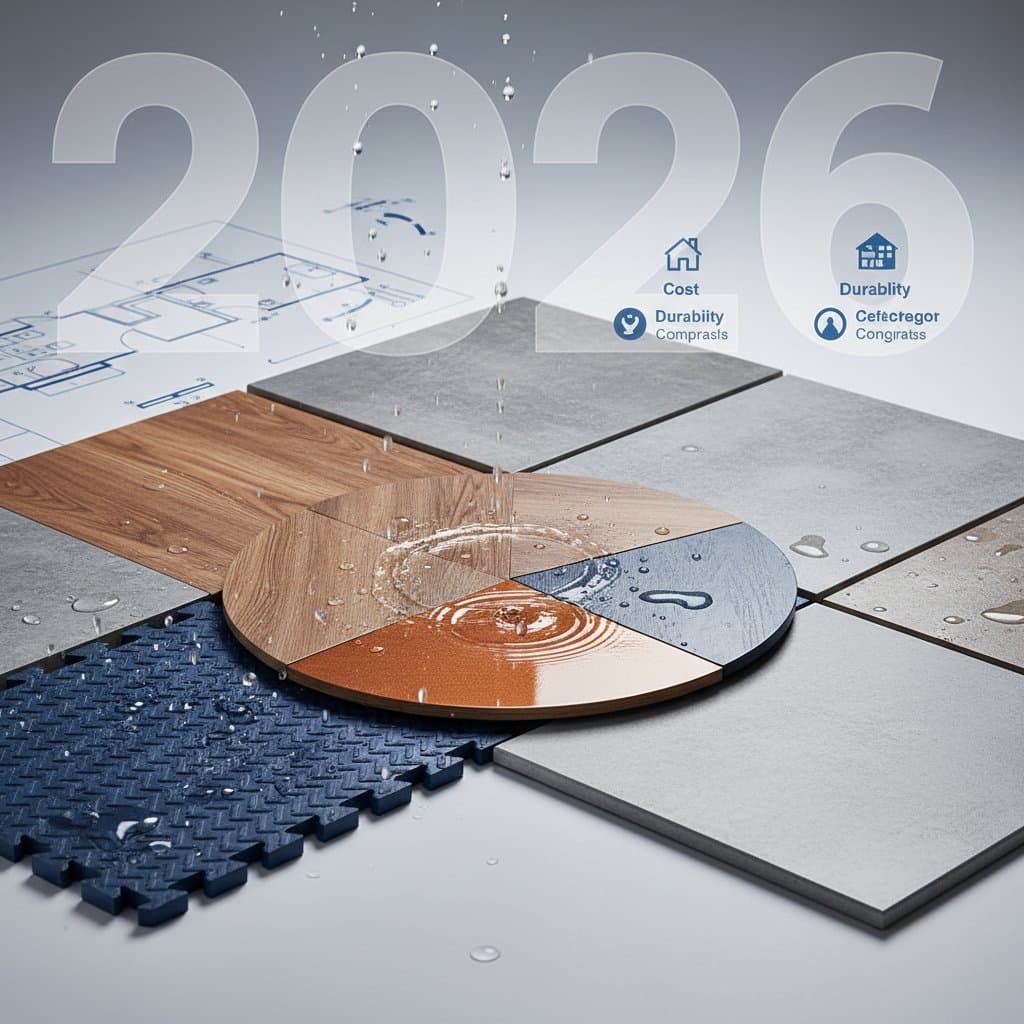
2026 Costs for Top Flood-Resistant Flooring Options
Homeowners in flood-prone areas increasingly select flooring that endures moisture, submersion, and frequent water contact. Flood-resistant flooring encompasses materials, installation techniques, and upkeep practices that reduce damage from water entry. Grasping these cost elements enables informed choices that safeguard property and finances over time.
What Makes Flooring Flood-Resistant
Flood-resistant flooring features materials that repel water absorption and retain shape after exposure to floods or high humidity. Key types include luxury vinyl plank (LVP), ceramic and porcelain tile, engineered rubber, epoxy coatings, and sealed concrete. These vary in expense, strength, repair ease, and eco-friendliness.
Evaluate each based on essential traits:
- Water impermeability, or resistance to moisture entry.
- Structural stability, meaning form and bond retention post-drying.
- Restoration simplicity, or cleanability and reusability after incidents.
Material Prices and Basics
Prices for materials fluctuate with quality and location. Entry-level LVP for basements begins at $3 per square foot, escalating to $8 for high-end versions. Porcelain tile falls between $4 and $10 per square foot, with labor adding $5 to $7 based on subfloor work.
Rubber flooring installed averages $6 to $9 per square foot, though interlocking heavy-duty variants surpass $12. Epoxy on concrete costs $5 to $10 per square foot by coverage and layer depth. Treated and polished sealed concrete ranges from $4 to $7 per square foot.
Factor in extras like underlayment, adhesives, vapor barriers, and moisture tests, which increase totals by $1 to $3 per square foot.
Cost Comparison Table
| Flooring Type | Material Cost (per sq. ft.) | Installed Cost (per sq. ft.) | Water Resistance Rating | Maintenance Needs |
|---|---|---|---|---|
| Luxury Vinyl Plank | $3 to $8 | $6 to $10 | High | Basic cleaning and periodic sealing |
| Porcelain Tile | $4 to $10 | $9 to $17 | Very High | Regrout after water exposure |
| Rubber Flooring | $6 to $9 | $9 to $12 | High | Reseal seams occasionally |
| Epoxy Coating | $5 to $10 | $7 to $12 | Very High | Recoat every 3-5 years |
| Sealed Concrete | $4 to $7 | $6 to $9 | Moderate | Annual resealing for protection |
Installation Steps and Associated Expenses
Installation unfolds in structured phases to ensure longevity. Start with an initial inspection where experts assess subfloor issues, test for moisture, and identify cracks.
Next, prepare the site by removing old materials and adding vapor barriers as needed. Proceed to installation, applying adhesives or sealants per manufacturer standards and finishing surfaces accordingly.
Allow curing time for epoxy and concrete to achieve full strength. Conclude with a review checking joints, drainage slopes, and seal wholeness. Skimping on preparation risks premature issues, whereas detailed sealing boosts endurance.
Potential Weak Points and Avoidance Strategies
No flood-resistant flooring proves invincible. LVP may buckle after prolonged submersion. Tile grout absorbs debris, necessitating renewal despite tile survival. Rubber seams lift under sustained pressure, and epoxy fractures if underlying concrete moves.
Failures often stem from skipped sealing, absent barriers, drainage flaws, or unsuitable adhesives. To counter these, integrate sump pumps, ensure proper subfloor sealing, and schedule routine checks.
Long-Term Financial Outlook
Ownership costs surpass initial outlays. Resilient materials demand more upfront but reduce replacements. A $8 per square foot LVP setup endures 15 years with light care, unlike standard laminate that fails after one flood.
Budget for upkeep like epoxy recoating at $2 to $3 per square foot every five years or tile grout at $1 to $2 annually. Review warranties for flood exclusions, especially below-grade events, to avoid surprises.
How to Select the Right Flooring
Follow this process for solid decisions:
- Gauge flood risk, from surface runoff to groundwater rise.
- Define budget limits, covering materials, labor, and future care.
- Weigh options on strength, cleanability, and recovery post-flood.
- Verify certifications for moisture and slip resistance from accredited labs.
- Vet installers for licenses, insurance, and flood project history.
This approach relies on facts over promotions.
Safeguarding Your Investment
Guard against subpar work by demanding moisture test records and seal details in writing. Scrutinize warranties for flood gaps and insist on itemized bills separating costs.
Confirm contractor qualifications via licensing offices and seek references from similar jobs. Expertise in both flooring and water control yields superior results.
Maximizing Returns on Flood-Resistant Choices
Opting for flood-resistant flooring offsets higher initial spends with damage prevention. An additional $2 per square foot in quality materials averts major repair bills. Integrate it into wider defenses like enhanced drainage and regular upkeep.
Sustained care through inspections and timely drying upholds aesthetics and function, delivering enduring home protection.