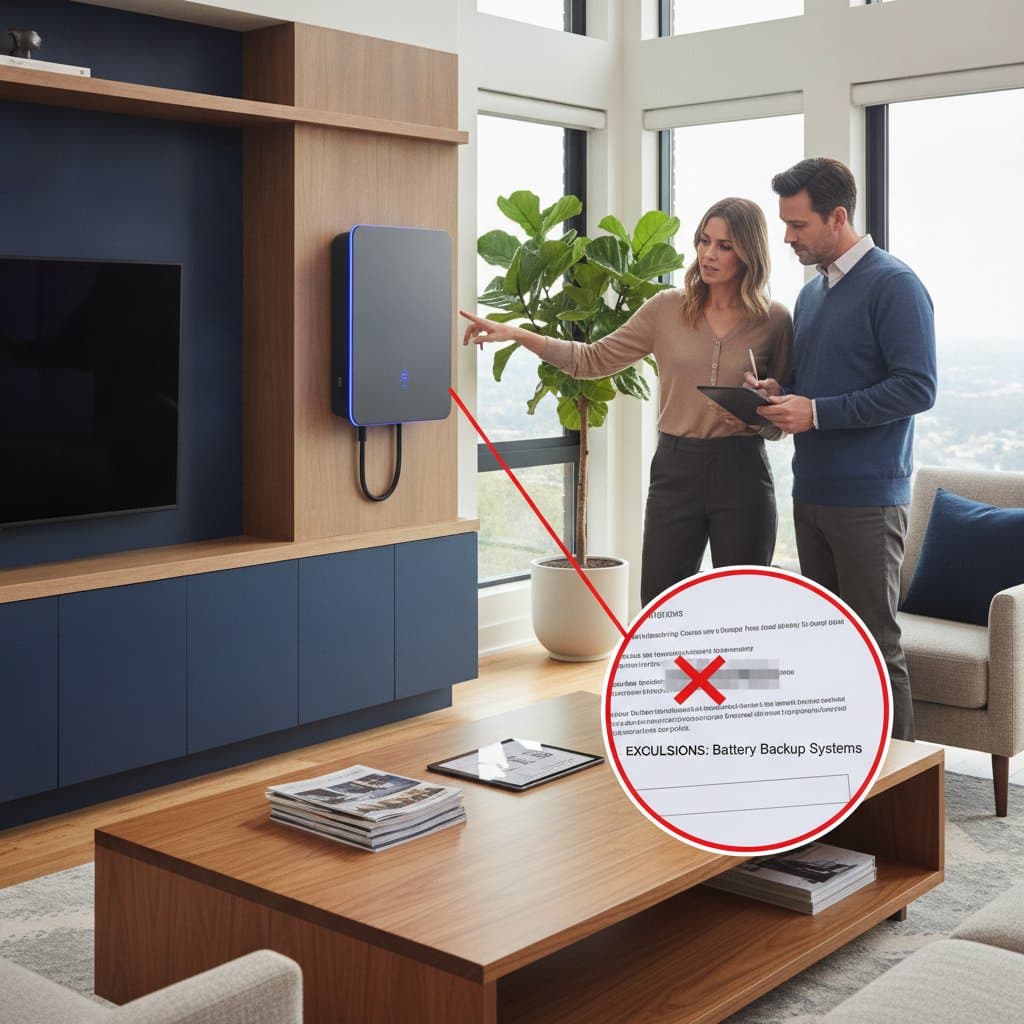
What Home Warranties Really Cover for Battery Backups
Homeowners adding battery backups often assume their home warranty will protect the system like any other appliance. In practice, coverage is limited. The fine print matters more than the marketing line. This guide breaks down what home warranties usually cover, what they exclude, how to read the policy, and when a manufacturer or installer warranty does the heavy lifting instead.
Pros, Cons, and Best Fit Scenarios
Coverage offers these advantages.
- Offsets service call or diagnostic fees for basic electrical issues
- Supplements manufacturer coverage once the original warranty expires
- Provides a single contact point for service scheduling
Limitations include these factors.
- Excludes most high voltage or renewable energy systems
- Limits payout per claim, often under the cost of a full replacement
- Requires strict maintenance documentation
A home warranty fits homeowners who already hold a broad policy and want partial support for connected electrical systems. It rarely pays off for high end battery installations or off grid systems that need specialized labor.
Step by Step Process to Check Coverage
- Gather documentation. Collect the home warranty contract, the battery manufacturer warranty, and the installation certificate.
- Find the system listing. Look in the covered items section for electrical, power storage, or renewable energy language.
- Check exclusions. Read the fine print for solar, battery, or energy storage. Many policies exclude these outright.
- Confirm service limits. Find the maximum payout per claim and per year. A two thousand dollar cap will not cover major replacements.
- Request clarification in writing. Ask the warranty provider if the specific model and installation type qualify. Keep this email or letter on file.
A quick call is not enough. Always obtain written confirmation before assuming coverage.
Mistakes to Avoid
- Assuming coverage. Many homeowners think a warranty covers anything electrical. It does not.
- Skipping maintenance logs. If the manufacturer requires annual inspection, missing it can void both warranties.
- Mixing brands or components. Using non approved inverters or breakers can trigger exclusion clauses.
- Performing DIY repairs. Opening a sealed battery enclosure can void all coverage instantly.
Keep installation and inspection paperwork in a single labeled file. Service providers will ask for it before approving work.
Pro Versus DIY Decision Rules
Use these guidelines to decide whether an issue can be handled directly or requires a professional.
- Skill fit allows only basic monitoring or app reset for safe DIY work. Any electrical or wiring work requires a professional.
- Safety risk stays low when reviewing system logs. It becomes high when opening panels or disconnects.
- Tool availability covers common hand tools only for DIY tasks. Insulated tools and meters are needed for professional work.
- Code compliance needs no permits for visual checks. Permits and inspection are required for any wiring.
If the issue involves voltage testing, arc fault diagnosis, or inverter replacement, call a licensed electrician. Warranty providers may deny a claim if work is performed without proper credentials.
Comparing Contractor Bids for Covered Work
Diagnostic service for a 240 volt system check and inverter test ranges from one hundred to one hundred fifty dollars across providers. Differences arise from travel distance and service fees. Battery replacement labor for a ten kilowatt hour unit swap ranges from one thousand eight hundred to two thousand four hundred dollars. Access and lift requirements drive the variance. Permit and inspection fees for a local electrical permit range from two hundred to two hundred fifty dollars based on municipal rates.
Always confirm that the contractor is approved by both the warranty provider and the battery manufacturer before scheduling work.
Verifying Your Specific Policy
Home warranties rarely cover the full cost of a battery backup repair. They can fill small gaps when configured correctly. Start by reading the warranty covered systems list. Then contact the provider to verify written inclusion for the model in question. Keep all maintenance logs and inspection records ready. If the system is new, rely on the manufacturer and installer warranties first. Use the home warranty as a secondary layer once those expire.
When in doubt, ask two questions before paying for extra coverage. Is the battery explicitly listed as a covered electrical system? What is the payout limit compared to replacement cost? If either answer falls short, skip the add on and invest in a maintenance plan with a certified installer instead. This route keeps the system safe, the coverage valid, and the backup power ready when needed most.