Solar Panel Maintenance: A 2025 Budget Breakdown
Homeowners install solar panels to reduce energy bills and achieve long-term savings. Routine maintenance ensures these systems operate at peak efficiency beyond the initial installation. This guide examines maintenance costs, essential tasks, and strategies for developing an effective annual budget. The focus remains on sustaining rated output levels with controlled expenses and limited interruptions.
Establishing Maintenance Frequency
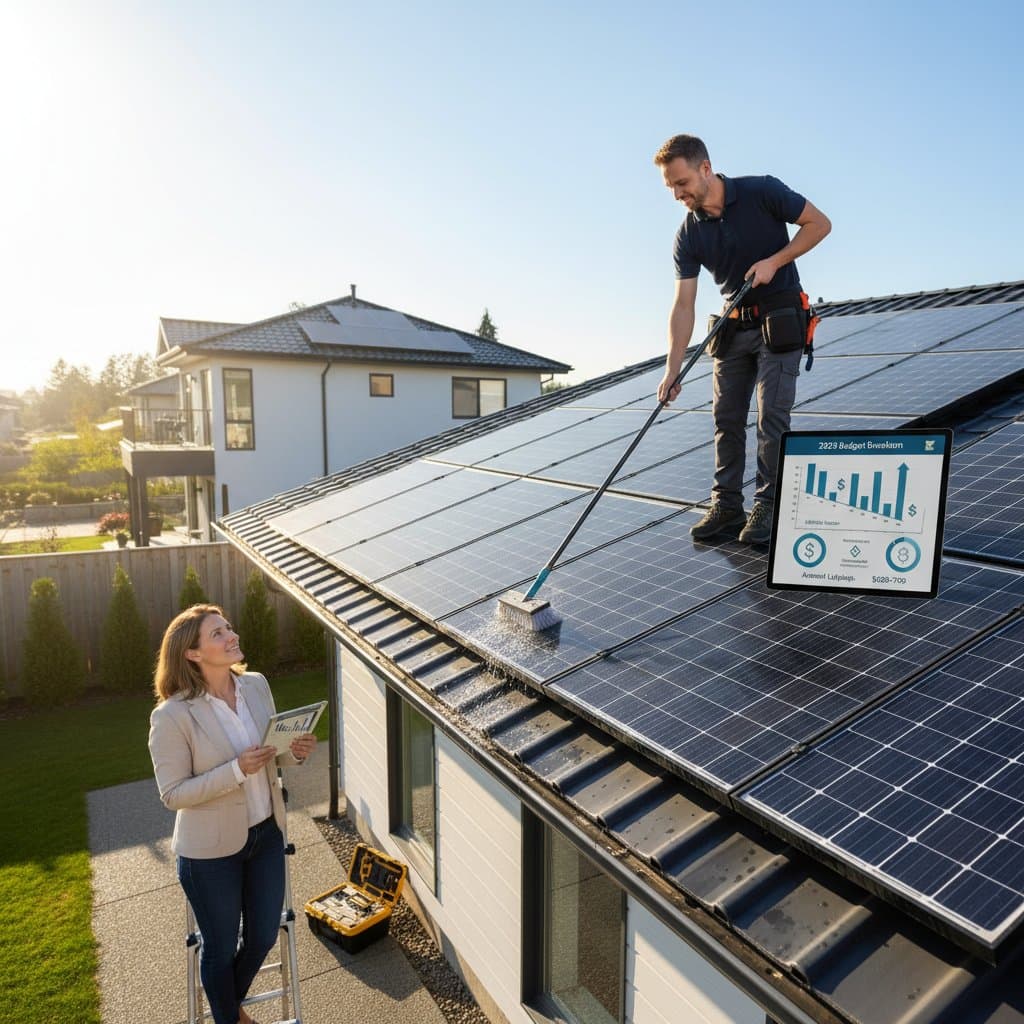
Solar systems typically require comprehensive cleaning one to two times annually. Annual inspections prove essential, complemented by continuous monitoring via inverter applications or dashboards. In regions with high dust levels, quarterly cleaning becomes necessary. Areas with regular rainfall and humidity often suffice with one annual cleaning.
Understanding Cost Drivers
Apply the three-factor cost driver framework to forecast maintenance expenses accurately.
- Materials Grade: Options range from basic detergents to advanced anti-static coatings for cleaning solutions, sealants, and replacement parts.
- Labor Complexity: Factors such as roof inclination, panel elevation, and wiring configuration influence required time. Roofs with steep pitches increase labor expenses by up to 20 percent.
- Site and Access Conditions: Challenges like restricted pathways, multi-level structures, or panels on delicate roofing extend preparation and safety measures.
For a straightforward single-story residence with a 6 kW system, yearly costs approximate $250. More intricate setups spanning multiple roof sections may approach $600.
Prioritizing Safety, Permits, and Compliance
Maintenance activities generally bypass permit requirements, though electrical repairs or inverter swaps may necessitate them. Consult local building authorities for confirmation. Safety protocols demand priority attention.
- Disconnect all breakers linked to the solar circuit prior to any inspection.
- Refrain from walking directly on panels to avoid creating microcracks.
- Employ outlets protected by ground fault circuit interrupters for cleaning equipment or pumps.
- Examine mounting hardware for signs of corrosion, particularly in coastal zones.
- Verify integrity of bonding and grounding connections during inspections.
Systems covered by manufacturer or installer warranties require thorough documentation, including timestamped photographs and service records, to preserve eligibility.
Addressing Common Issues and Solutions
Several persistent problems generate the majority of service requests.
- Reduced Power Output: Inspect for accumulated debris, shading effects, or faulty fuses. Initiate cleaning procedures, followed by performance retesting.
- Inverter Error Indications: Perform a reset according to the provided manual. Persistent errors warrant intervention from a certified solar professional.
- Secured Wiring Connections: Thermal fluctuations lead to expansion and contraction, potentially loosening terminals. Secure connections to specified manufacturer torque values.
- Damaged Glass Surfaces: Initiate immediate panel replacement. Water penetration risks short-circuiting cells and invalidating warranties.
- Corrosion Development: Apply anti-oxidation compounds to exposed metals and substitute deteriorated connectors.
Evaluating DIY Versus Professional Services
Employ the DIY gate framework to guide decision-making.
- Skill Assessment: Individuals capable of secure roof access and basic electrical evaluations may handle tasks independently.
- Safety Evaluation: Roofs exceeding 25 degrees in pitch or panels positioned near edges necessitate professional assistance.
- Tool Readiness: Absence of specialized equipment, such as extension poles, fall arrest systems, or digital multimeters, indicates the need for expert services.
Independent cleaning efforts limit expenses to under $50 for supplies. Professional services, encompassing cleaning and inspections, typically range from $300 to $400 and incorporate safety assurances, liability coverage, and performance documentation.
Developing a Comprehensive Maintenance Plan
Solar panels endure for 25 years or longer, yet ancillary components like inverters and connectors demand vigilant oversight. The maintenance cadence framework facilitates proactive scheduling.
Post-Installation Steps
Document initial output metrics from the inverter interface. Clearly label all disconnect switches and breakers for rapid emergency access.
Seasonal Routines
Conduct panel cleaning in spring or following extended dry spells. Evaluate alterations in shading from vegetation growth or nearby constructions.
Annual Procedures
Arrange complete inspections paired with performance evaluations. Analyze monitoring records to detect variations in output across years.
System Decommissioning
Utilize certified recycling programs for panels and inverters at end-of-life. Retain disposal documentation to satisfy regional environmental regulations.
Consistently maintained panels preserve 95 percent of their original output capacity after ten years of service.
Comparing Maintenance Contract Proposals
For those opting for ongoing service agreements, obtain bids from at least three providers. Each proposal must delineate service scope, intervals, and reporting protocols.
| Line Item | Specification or Scope | Contractor A | Contractor B | Contractor C | Variance Notes |
|---|---|---|---|---|---|
| Annual Cleaning | Soft brush and deionized water | $180 | $220 | $250 | Differences in access fees |
| Full Inspection | Electrical verification, torque testing | $120 | $150 | $130 | Variations in labor hours |
| Monitoring Report | Monthly data submissions | Included | $50 | Included | Optional additional service |
| Emergency Response | Availability within 48 hours | $150 | $200 | $180 | Influenced by travel distance |
Examine evidence of insurance, warranty extensions, and contract termination conditions prior to commitment.
DIY Maintenance Preparation Checklist
| Category | Essential Items or Considerations |
|---|---|
| Tools Required | Extension pole, soft-bristle brush, bucket, squeegee, garden hose |
| Skills Required | Secure roof navigation, proficiency with basic hand tools, multimeter operation |
| Safety Equipment | Non-slip footwear, protective gloves, harness system, hard hat |
| Permit Requirements | Generally unnecessary for cleaning; electrical tasks may require approval |
| Preparation Steps | Deactivate inverter, secure ladder placement, assess weather conditions |
| Site Limitations | Postpone during extreme heat or strong winds |
Consequences of Neglected Maintenance
Failure to maintain solar systems diminishes lifetime energy production by 20 percent or greater. Accumulated dirt impairs light capture, and untreated corrosion propagates across connectors. A malfunctioning diode or unsecured wire disrupts entire panel arrays. Imbalanced loads accelerate inverter overheating and premature failure. Moreover, overlooked upkeep risks nullifying performance guarantees, shifting substantial replacement burdens to owners.
Scheduling and Executing Annual Maintenance
Standard cleaning and inspection sessions last approximately two hours for single-array systems. Configurations with multiple arrays extend to four hours. Additional inverter diagnostics or wiring adjustments may require a half-day commitment. Time services for dry conditions to ensure safe access. Morning sessions optimize safety and cleaning efficacy, avoiding midday heat.
Indicators of High-Quality Service Delivery
Examine panels for residue-free, streakless finishes post-service. Confirm wire restraints prevent roof abrasion. Ensure junction boxes remain sealed and identified. Verify mounting fasteners achieve proper torque without looseness. Request service documentation detailing voltage, current, and inverter efficiency metrics.
Professionals supplying pre- and post-service output comparisons demonstrate tangible benefits.
Diagnosing Output Declines
Persistent reductions in monitoring data demand systematic investigation.
- Review Weather Records: Extended overcast conditions may conceal underlying issues.
- Examine Accessible Areas: Identify accumulations from birds or substantial debris.
- Measure Inverter Voltage: Contrast readings against installation baselines.
- Inspect Wiring and Fuses: Substitute components exhibiting rust or fading.
- Engage Certified Expertise: Summon a qualified solar electrician for unresolved underperformance.
Securing Long-Term System Performance
Implement these strategies to maximize solar investment returns. Regular upkeep safeguards efficiency, extends operational life, and upholds warranty protections. Homeowners who budget wisely for maintenance enjoy sustained energy savings and system reliability well into the future.